Most players think the cable is the safe choice. It's familiar. It works. It doesn't need charging.
But think about what a cable actually asks you to do every single time you play.
You bend down to plug in. You stand back up. You stay close to the amp. You watch where you step. You untangle it before you start. You make sure nobody walks through it.
If your back hurts, your knees ache, or your hands are stiff, every one of those steps has a price.
One player on Sweetwater said he had to replace the output jack on every one of his basses because people kept stepping on his cable. Another said he and his wife got so tired of tripping over the guitar and mic cables that she was the one who pushed him to find something better.
This isn't just about being annoyed. For a lot of players, it's a real physical problem.
The cable limits where you can stand. It asks something of your body every time you use it. And if bending down is hard, or your balance isn't perfect, that small daily thing adds up to a big reason to play less.
The cable feels safe. But familiar and safe aren't the same thing.
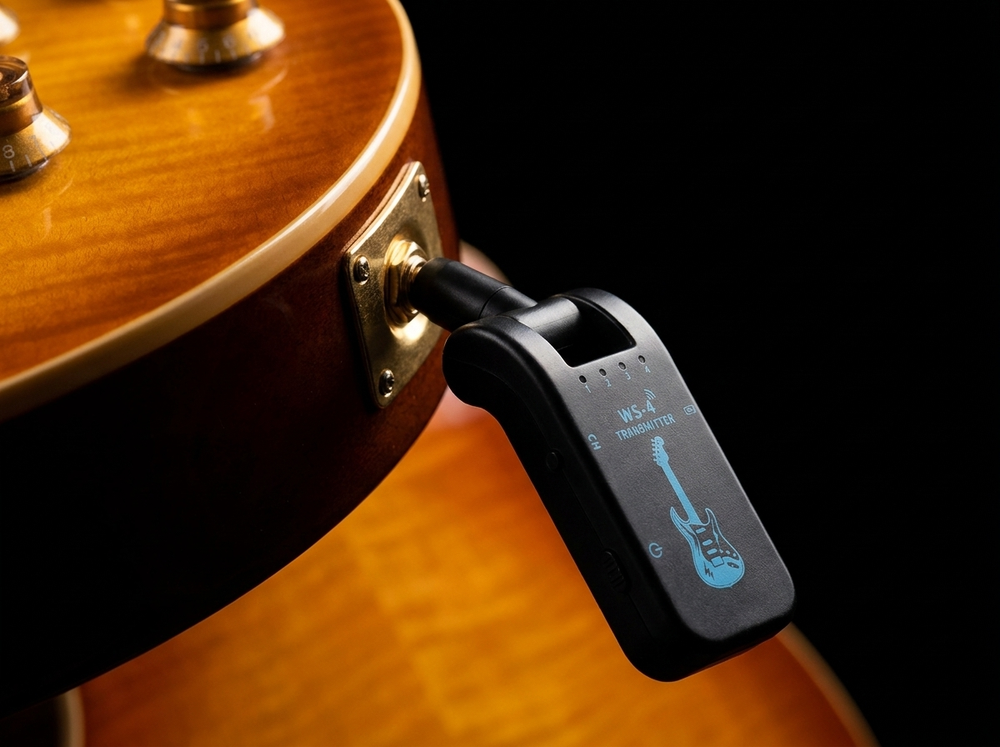
When players say wireless kills their tone, they're usually right about what they heard. It happened to them. Or they read enough stories about it that they treat it as fact.
Highs that went dull. Signal that felt squashed. A sound like someone put a blanket over the amp. Budget wireless systems really do this. Cheap parts really do hurt your tone. The market's fear is based on real experience.
So when most wireless brands say "crystal clear sound" or "studio quality audio," players who've been burned before just roll their eyes. They don't need nice words. They need a real reason to believe this time is different.
Here's the real reason.
A cable isn't perfectly neutral to begin with. Shure and Sweetwater both explain this: a standard guitar cable rolls off high frequencies, especially with passive pickups. The longer the cable, the more it softens the sound. What most players call their "cable tone" already has some of that softness baked in.
ToneLink transmits at 48kHz, 16-bit in real time. It captures your full signal before any of that cable coloration gets added. The result isn't "better than your cable." It's just your guitar, as it actually sounds, without the frequency loss a long cable brings in.
95% of ToneLink players say they hear no difference in real use. Not in a studio. In rehearsals, gigs, and home sessions where the whole point is to stop thinking about gear.
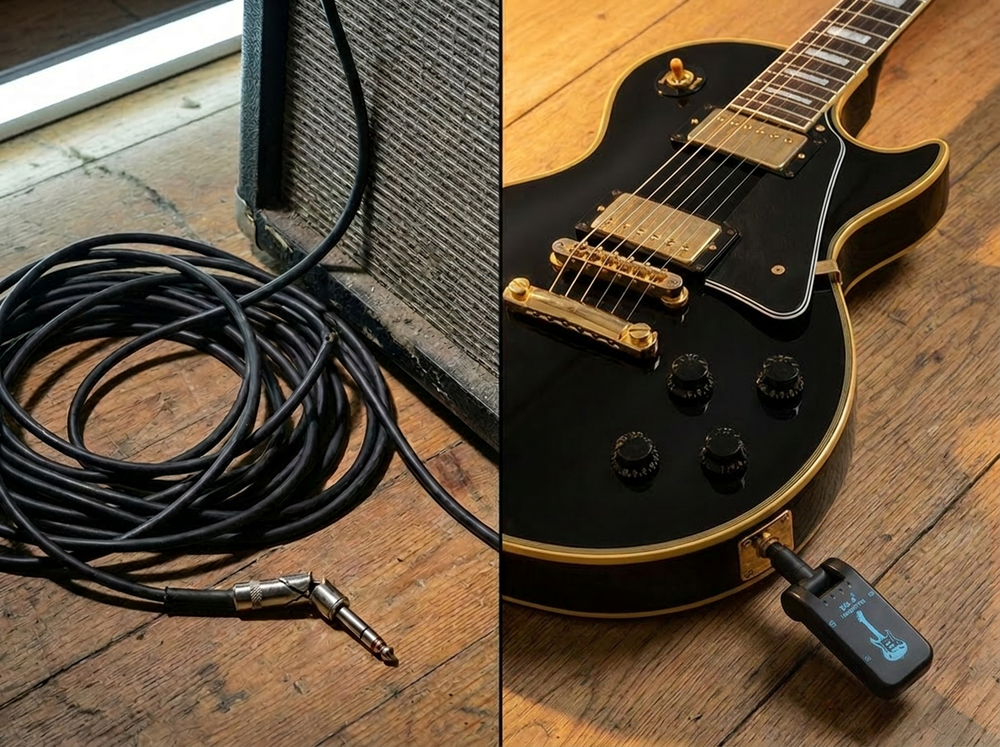
The dropout fear is the biggest reason players stay on a cable. And it's a fair fear.
One guitarist on Reddit wrote about hitting the first note of his set and hearing total silence. He had to run offstage to find a backup cable while his band stood there waiting. That story gets shared all the time because it's exactly what every gigging player is afraid of.
But dropouts don't happen by accident. There's a reason.
Most cheap wireless systems run on the 2.4 GHz band. That's the same band used by every Wi-Fi router, every Bluetooth speaker, and every wireless mic in the building. In your living room with one router, it works fine. In a bar with 15 Wi-Fi networks all fighting for the same space, the signal starts dropping. The system isn't broken. It's just losing a fight it was never built to win.
ToneLink watches the spectrum in real time across 8 selectable channels. When interference shows up, the system finds a cleaner channel on its own. Players have run it in churches with full PA systems, in bars with five Wi-Fi networks, and in packed rehearsal spaces. Same answer every time: it held.
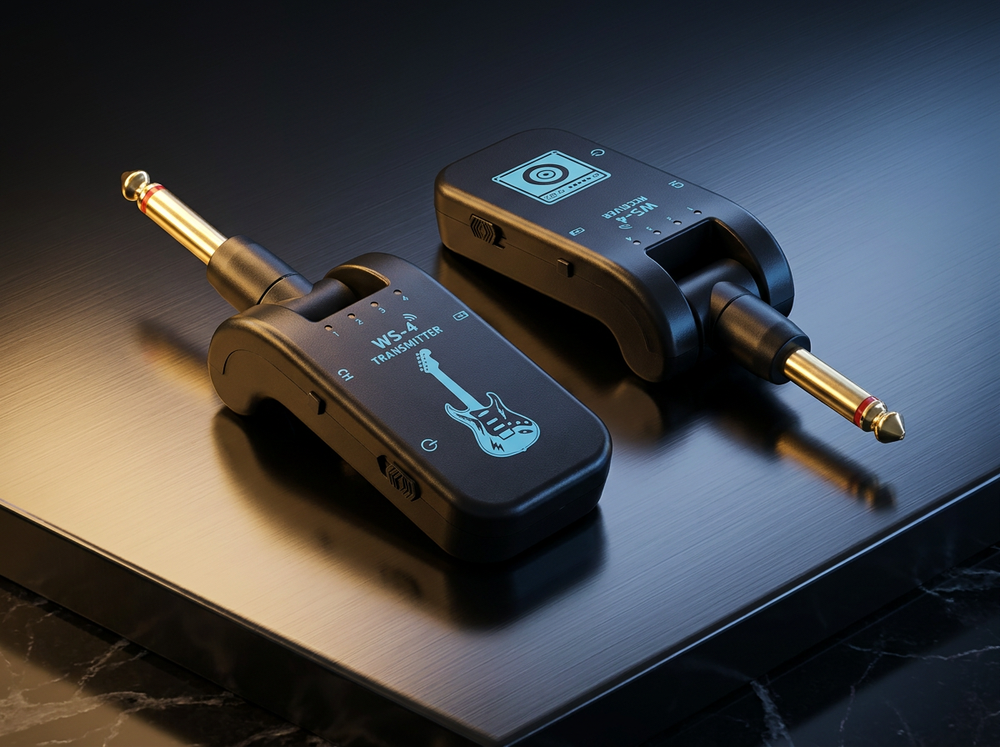
The question isn't "does it work?" The question is "how much new stuff do I have to deal with to get rid of my cable?"
Players who've been burned before know exactly what that new stuff looks like. The pairing steps. The firmware update that broke something. The blinking light that meant something was wrong but the manual wasn't clear about what. They got rid of their cable and ended up with a whole new set of problems.
ToneLink has no app. No pairing. No setup steps before every session. You plug the transmitter into your guitar. You plug the receiver into your amp or pedalboard. You play.
That's it.
The battery lasts up to 10 hours on a single charge. No separate charger to lose. No AA batteries to hunt for at 7pm before a gig. No wondering if the batteries from last week still have enough juice.
One charge. Ten hours. Plug in. Play.

The box says "works with any guitar." Then you get home and find out it does something weird with your active pickups. Or the level is off with your bass. Or it sounds fine on its own but something gets strange when you put it in front of your pedalboard.
ToneLink works with passive and active pickups, electric guitar and bass, and sits cleanly in front of a pedalboard without messing up the level or the tone. The 131-foot range holds up in real rooms with real people in them.
For players with mobility problems, this range means something specific. It's not about jumping into the crowd. It's about being able to sit down. Being able to play from a chair on the other side of the room. Being able to move to wherever is comfortable, not wherever the cable reaches.
131 feet means you go where you want. Not where the cable lets you.
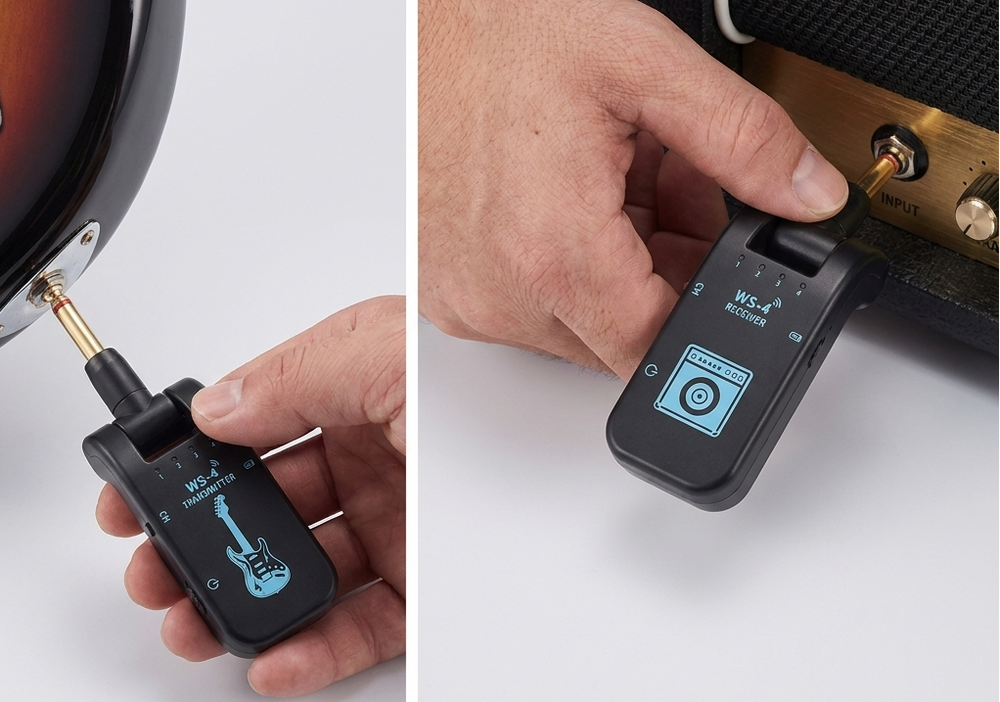
Most wireless brands skip this one or hide the number where no one will find it.
Here it is straight.
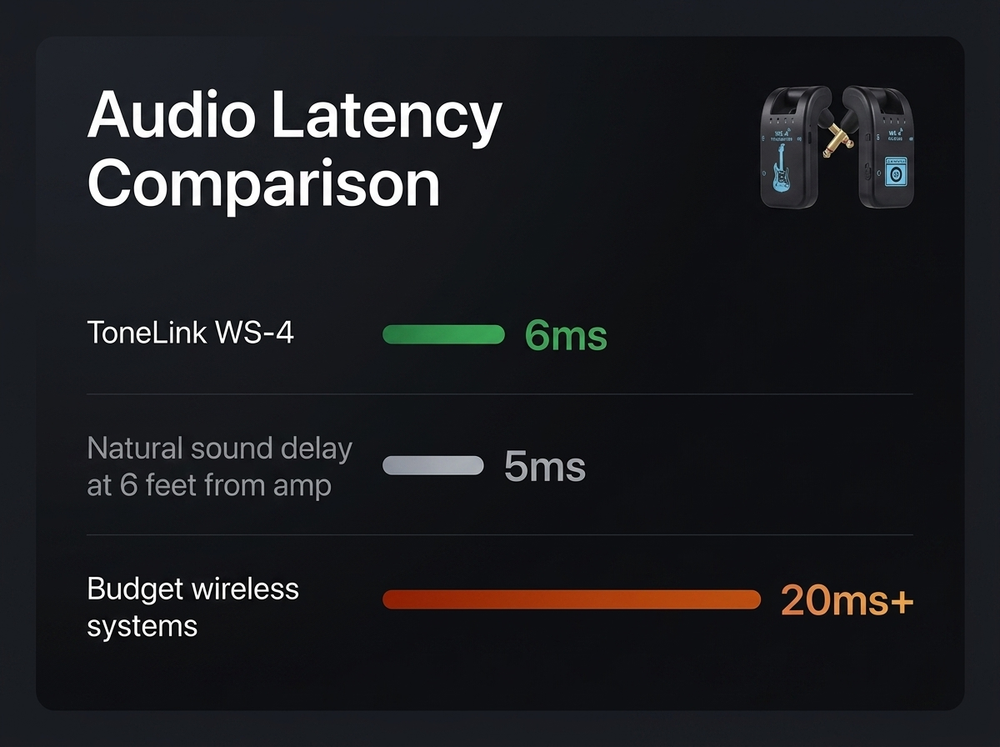
ToneLink has about 6ms of latency. That means the signal takes 6 milliseconds longer to get from your guitar to your amp than it would through a cable.
When you stand 6 feet in front of your amp, the sound takes about 5ms just to travel through the air and reach your ears. The gap you're worried about is already smaller than the gap you deal with every time you stand in front of a speaker.
Most players put the problem zone around 8 to 10ms. That's where timing starts to feel off, especially if you practice with a metronome or run a lot of digital processing. At 6ms, ToneLink is below that line for most setups.
"Virtually zero latency" is a nothing phrase. This is the real number. Make your own call.
For the players this was built for, the ones who plug in and play, it will feel like a cable. That's not a sales line. That's what 12,000 players said.
Even after all of that, one thought still stops people.
"What if this is just another bad wireless system?"
That's not a dumb thought. It comes from real experience with products that promised a lot and didn't deliver. It's not a logic problem. It's a trust problem. And the only real fix for a trust problem is to take away the cost of being wrong.
ToneLink comes with a 60-day trial and a 2-year warranty.
Not 30 days. 60. Two full months of real use. Rehearsals, gigs, home sessions, all of it. If it cuts out at a gig, if your tone sounds different, if it adds any new hassle to your life, send it back. Full refund. No argument.
The 2-year warranty means if anything goes wrong with the hardware, you're covered. This isn't a product that expects to come back. It's a product that expects to still be in your rig in two years.
For players with mobility problems, pain, or just a body that's taken 30 years of playing, this isn't really about convenience. It's about how much you actually pick up the guitar. Every small thing that makes playing feel like more work than it should be is a reason to leave it in the case. Remove enough of those things and you play more. Not because the gear is exciting. Because it stopped getting in the way.